| TL;DR: AI recruitment platforms are popular because manual hiring breaks at scale. There are too many applicants, too much admin, and inconsistent screening. The tools in this list help you move faster by compressing sourcing and shortlisting. Global Skills is the faster path when the real goal is speed-to-hire without compromising quality, because it focuses on deploying job-ready engineers who can contribute from day one, especially for urgent or high-risk roles. |
Hiring for IT roles today often requires doing the same work in multiple places.
You search through your applicant tracking system. Then post on job boards. And share on LinkedIn, hoping to find the right talent.
No matter the position, chances are you end up going through piles of resumes that look fine on paper but do not match the real skill bar.
This is exactly why AI-powered recruitment platforms have taken off. They help you search faster across more sources, rank candidates by stronger signals, and reduce the manual grind in shortlisting.
In this article, we have shortlisted 7 AI-powered recruitment platforms that can help you hire the right IT talent for your organization’s needs. We have also added one smarter option for recruiters who want to cut through the noise and get ready to hire talent faster.
But first, let’s get into the list.
7 AI-Powered Recruitment Platforms That Support IT Hiring in 2026
Did you know that most hiring teams are not adopting AI to replace recruiters? They are adopting it to improve efficiency and get time back.
When sourcing is spread across platforms, a big chunk of the week gets spent on search, shortlist building, and repetitive admin. That is why efficiency shows up as the biggest win when using AI.
In fact, the LinkedIn Future of Recruiting 2025 Report highlights that users experimenting with or integrating generative AI in hiring reported saving about 20% of their work week.
On that note, here are 7 AI-powered recruitment platforms that support IT hiring in 2026.
Uplers
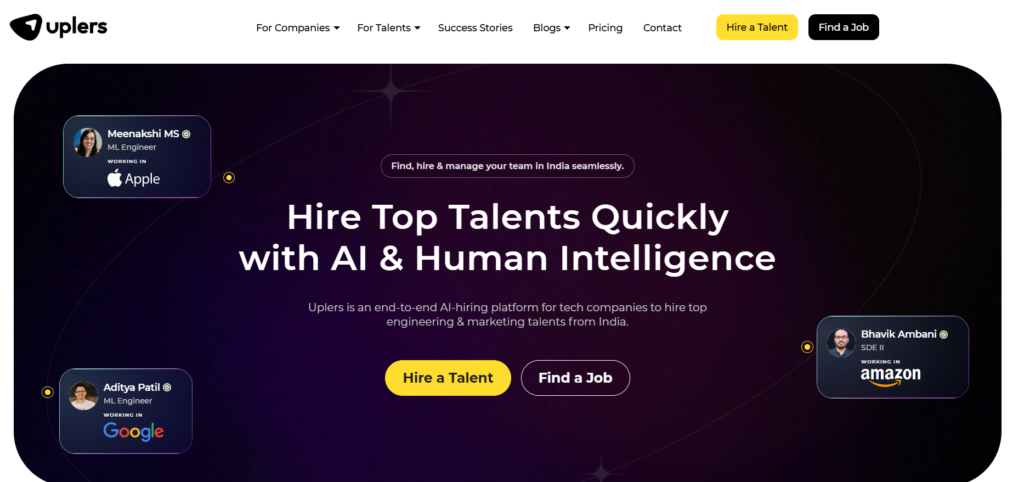
Uplers is an end-to-end AI hiring platform that helps companies hire and manage talent from India, with a strong focus on IT roles.
They combine AI filtering with human review so hiring teams can move faster without drowning in irrelevant resumes. The idea behind the dual-layer model is that software helps cut the resume pile down, and their team steps in to sanity check what makes it through.
Source – Uplers
The approach is simple. You define the requirement. They share 3-5 pre-vetted profiles within 48 hours, and you can go ahead with the interview process. Once you have made the decision, they support onboarding.
To make evaluation easier, they also show detailed candidate profiles like professional summaries, major projects, work history, intro videos, and verified profiles
The IT roles they offer include Software Engineers, AI and ML Engineers, Full Stack Developers, Data Scientists, DevOps, Solutions Architects, and QA Engineers.
Uplers positions itself beyond engineering and offers hiring across multiple functions, including:
- Marketing roles like SEO, Programmatic, SEM, and PPC.
- Design roles such as UI/UX, web design, and graphic design.
If a company is hiring tech plus supporting growth roles, Uplers tries to cover both under the same umbrella.
Pricing
Uplers publishes pricing ranges based on “personas” and role types. They also mention full-time and contract options. You can visit their pricing page for more information.
Ratings
G2 – 4.7/5
Instahyre
Instahyre is an AI-powered recruitment platform designed to make sourcing easier for recruiters. It uses AI to surface candidates who are open to new opportunities and highlights that its matching accuracy can compete with strong human recruiters, albeit at scale.
They also highlight immediate business impact, sharing that recruiters see a 2-3 times increase in the number of candidate interviews when using the platform.

Source – Instahyre
Instahyre also tries to solve the outreach problem. They support candidate engagement through automatically generated personalized emails, so recruiters can reach out faster while keeping messaging relevant.
The Instahyre platform supports hiring across multiple functions, including Software Engineering, Information Technology, Data Science, Product Management, Design, Marketing, Sales, Operations, and HR.
Additionally, they also offer the option to add employer branding into the platform, with mobile-friendly and multimedia-enabled company profiles to showcase culture.
Pricing
Instahyre offers a free plan that provides users with a limited number of profiles monthly. For unlimited usage and additional features, they offer subscription plans, which you can find out more about by contacting their team.
Ratings
G2 – 4./5
Recommended read: 11 IT Staff Augmentation Companies in India for Flexible Tech Hiring. Explore leading firms helping enterprises scale engineering teams quickly.
Cutshort
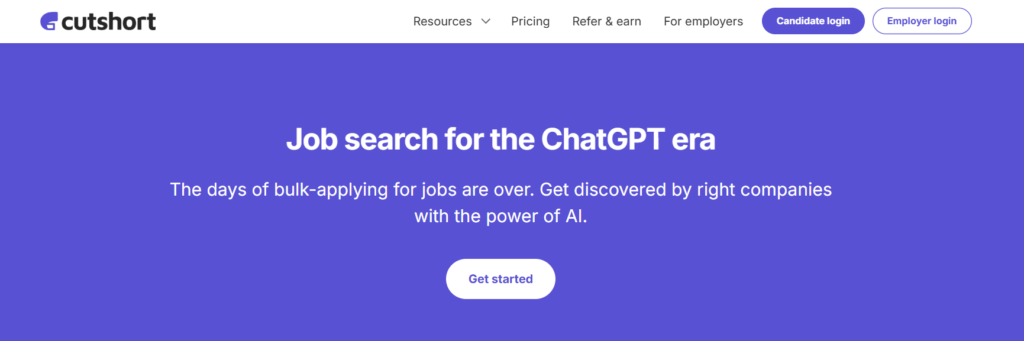
Cutshort is an AI-driven hiring platform focused heavily on tech roles in India.
They are built to solve a frustration most tech recruits face: Traditional job boards push bulk applications, resulting in bulk applications. Resultantly, a lot of reviewers’ time gets wasted on trying to find a few relevant candidates.
Source – Cutshort
They offer an AI-first job search and hiring platform where candidates upload a resume, and companies invite the right profiles to interview. For employers, they frame it as a sourcing platform for technology roles that canhelp you move faster without screening a large pile of less relevant resumes.
They also give companies flexibility in how they use the platform. Companies can either hire on their own through a self-serve subscription or use their vendor-style offerings, where their team helps you find candidates.
Based on their job categories page, Cutshort supports core tech roles like product engineering, frontend, backend, Android, iOS, DevOps, and data science. They also cover adjacent roles like product management, UX and graphic design, digital marketing, and broader marketing and sales.
Pricing
Cutshort offers two pricing plans for employers. Their Startup Support plan is listed at ₹1.59L per year, and their Teams plan starts at ₹7.99L onwards per year. Both plans include unlimited resume views and unlimited job postings.
Ratings
G2 – 4.6/5
Turing
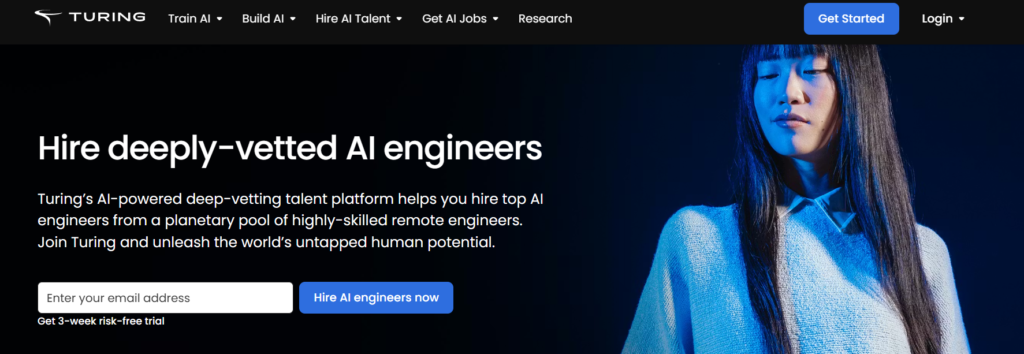
Turing is an AI-powered talent platform built for recruiters who need deeply vetted remote engineers, with a strong push around AI and GenAI-heavy roles.
Source – Turing
Their flow is straightforward. You share the skills and the scope of the role. They line up vetted profiles within days. You meet the developers you like, and you can start with a risk-free trial before committing long-term.
What stands out in their approach is the speed and vetting bundle. They highlight that most roles get filled in around 4 days, because they front-load the hard work: sourcing, technical screening, and matching.
They also position their vetting process as majorly software-led. You still get to interview the shortlist, but the platform is built to reduce the “maybe” pile and bring you candidates who are closer to ready.
The roles they support include AI/ML Engineers, NLP Engineers, Computer Vision Engineers, Data Engineers, Data Scientists, plus core software roles like Full Stack, Backend, Frontend, DevOps, and Mobile.
Pricing
Turing does not share pricing on their website. They push the risk-free trial as the starting point, then you go contract-style based on the role and setup.
Ratings
G2 – 4.2/5
SeekOut Spot
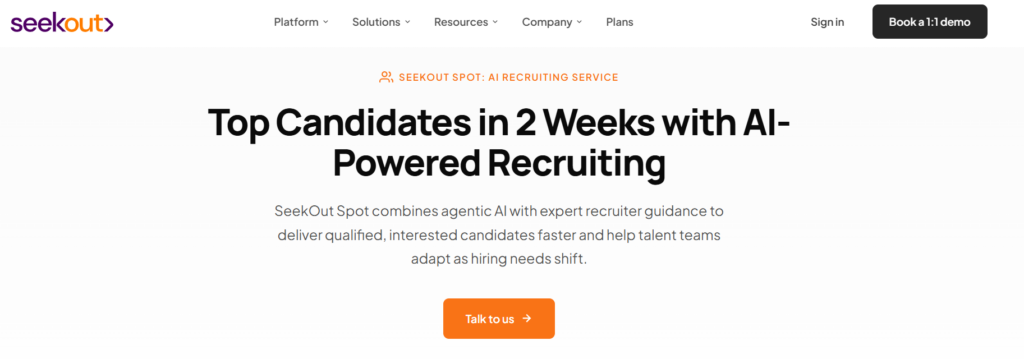
SeekOut Spot is an AI recruiting service built for recruiters who want interview-ready candidates without running a full sourcing engine.
Source – SeekOut
SeekOut positions Spot like an “AI + recruiter” delivery model where AI does the heavy lifting (research, matching, outreach), while recruiters guide quality and keep the shortlist tight.
Their process is structured like a 2-week sprint. It starts with a kickoff to lock required vs preferred skills, then they source and evaluate profiles, run multi-step outreach campaigns, and finally screen candidates so the profiles reviewers receive are relevant.
SeekOut offers different engagement models depending on how you want to use them: a per-role model for filling specific positions, a contract-recruiter model to add recruiting bandwidth, and an outcome-aligned model that’s positioned as an alternative to traditional recruiting agencies.
They are best suited for organizations hiring for Tech, AI, and GTM roles that need speed without sacrificing quality.
Pricing
SeekOut offers custom pricing based on the engagement models. You can contact their team for more information.
Ratings
G2 – 4.5/5
HackerRank
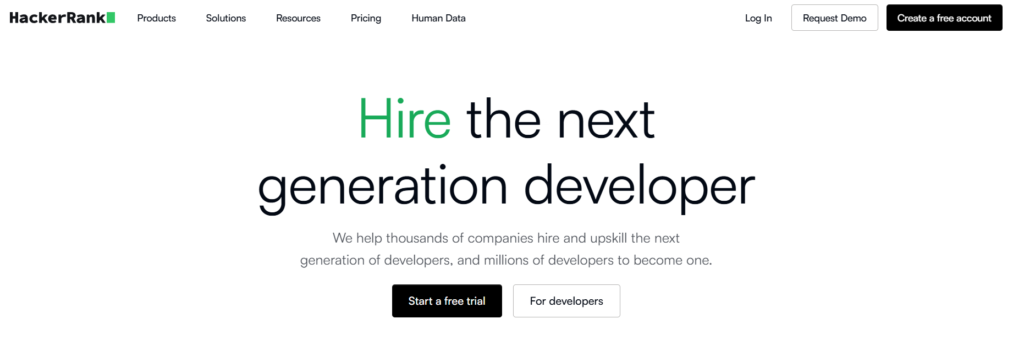
An unconventional addition to the list, HackerRank runs a massive public developer community where engineers practice, certify skills, and discover jobs.
The company also offers a Developer Skills platform that is used by companies to evaluate and hire technical talent using structured assessments and technical interviews
Source – HackerRank
For recruiting teams, HackerRank’s value lies in two core workflows: Screen and Interview. Screen is built for structured coding assessments, whereas Interview focuses on real-time technical evaluation in an interview setting.
What makes them different from pure talent providers is that they don’t send you candidates by default. They give you the system to measure skill consistently at scale, so you can shortlist faster and reduce the number of interviews wasted on weak fits.
In fact, HackerRank explicitly claims companies can reduce time-to-hire by 50%. Moreover, companies can use HackerRank’s engagement products (like hackathon-style challenges) to strengthen top-of-funnel interest when hiring at scale.
Pricing
HackerRank shows tiered plans on its pricing page: Starter ($165/mo billed annually), Pro ($375/mo billed annually), and Enterprise (custom), with usage structured around candidate attempts and plan-level feature access.
Ratings
G2 – 4.6/5
LinkedIn Recruiter + Hiring Assistant
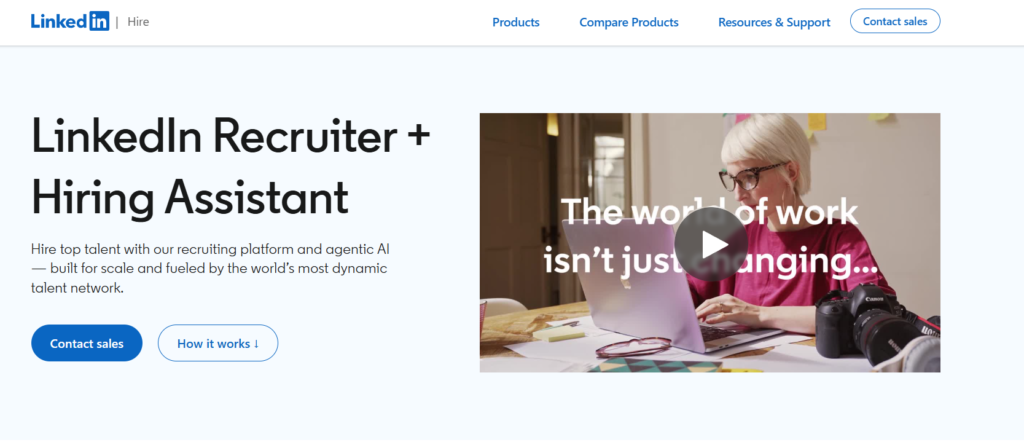
LinkedIn Recruiter + Hiring Assistant is the popular social network’s AI-powered recruiting platform built on top of its 1 Billion+ verified professional network. If you want the widest possible talent pool across various roles, this database play is a must-check.
Source – LinkedIn
What makes this hiring product distinct is the AI layered on top of LinkedIn’s network + Recruiter workflows, so your team can source faster without losing control.
You share your hiring goals, and it searches, reviews, and delivers a summarized shortlist of candidates. It also adapts to your feedback, so the recommendations improve over time. LinkedIn claims customers report saving more than 4 hours per user, per role with Hiring Assistant.
When you want to take over manually, Recruiter still gives you the classic sourcing engine with 40+ advanced filters plus keyword and Boolean search. So you can use AI for speed, then switch to manual mode when you need precision or want to expand the search in specific directions.
Pricing
LinkedIn does not publish pricing for Recruiter + Hiring Assistant on their website. You can contact their team for more information.
Now that we have covered these 7 AI-powered recruitment platforms, it’s helpful to understand why they are preferable to manual recruiting tools.
5 Reasons Organizations Prefer AI-Powered Recruitment Platforms for Hiring
To put it simply, manual hiring breaks at scale. There are too many moving parts, and too much of it is repetitive. That’s what these AI-powered talent acquisition platforms can solve. Here’s how:
They compress the shortlist cycle: Instead of spending days searching and filtering, recruiters get a tighter shortlist faster, with fewer “maybe” profiles.
They reduce the busywork that slows hiring down: Outreach drafting, follow-ups, scheduling, and pipeline movement stop living in spreadsheets and scattered inbox threads.
They improve signal quality beyond resumes: Many platforms use richer signals (skills, projects, assessments, and past ATS data), so selection is not based only on keyword matching.
They make screening more consistent: Structured assessments and repeatable evaluations reduce variance across interviewers and help recruiters defend hiring decisions internally.
They help recruiters actually engage candidates at scale: Personalized outreach workflows and better targeting typically improve response rates, which matters when good talent has options.
While most of these platforms help you hire better, there is still a catch. They depend on your team to run sourcing, screening, interviews, and closing well.
So if your real goal is speed-to-hire for critical IT roles (without compromising quality), there is another route: an execution-led model that delivers ready-to-deploy talent faster.
That is where Global Skills come into play.
Global Skills: A Faster Way to Hire job-ready IT engineers
The AI recruitment platforms listed above can help you find candidates faster. But they still leave the hardest parts on your plate. That is, validating real capability, reducing ramp-up time, and ensuring the person actually performs once they join.
Global Skills is built to solve that problem, too. We offer an execution-led hiring model that is designed to deploy job-ready engineers who can contribute from day one. This is crucial, especially when timelines are tight and the cost of a wrong hire is high.
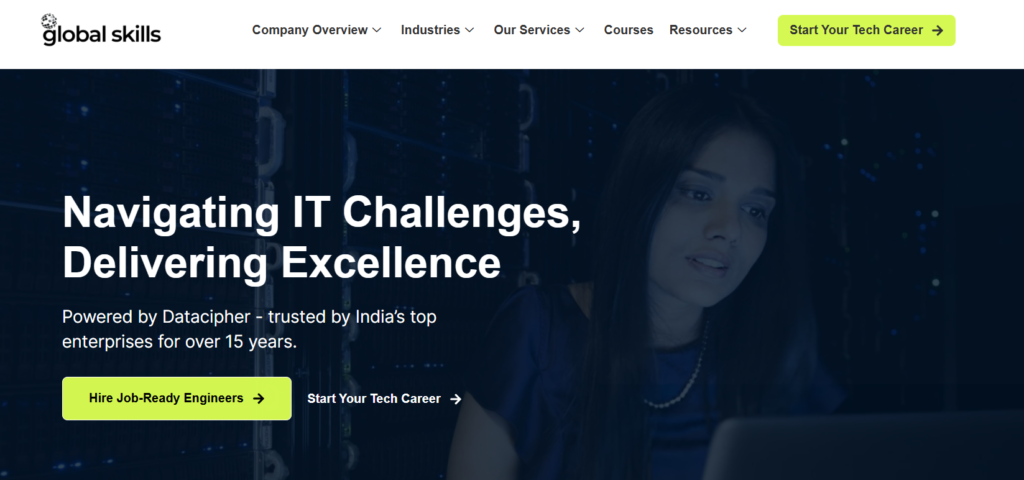
Source – Global Skills
Powered by Datacipher’s 15+ years of enterprise training experience, Global Skills combines training, readiness validation, and talent deployment in one system.
Instead of optimizing for resume volume, we optimize for capability. Our engineers are trained through official vendor programs, vetted by experts, and screened against practical, role-aligned requirements. So recruiters are not starting with potential. They are starting with deploy-ready.
This approach also reduces the internal burden most tool-based workflows create. You do not need to run sourcing across multiple channels, chase responses, or build screening pipelines from scratch. You get a shortlist that is closer to interview-ready, with clear information on skills, projects, and real-world exposure.
And if the exact skill mix is scarce, Global Skills can activate hire-train-deploy programs to build role-aligned talent rather than having your teams train internally.
In fact, this is not the only model we offer. We support enterprises through multiple workforce and delivery models, including:
- Permanent hiring for roles that need long-term stability
- Contract staffing for project-driven capacity
- Contract-to-hire when you want performance proof before conversion
- Contingent staffing for time-bound, compliance-managed deployments
Beyond hiring, we cover what most AI tools don’t: workforce operations. Global Skills can manage compliance, contracts, and payroll for deployed engineers, so your HR and talent acquisition teams don’t carry admin risk.
And when you need outcomes, not just capacity, we also offer managed services where we take ownership of execution through delivery-led engagements.
So, while the above AI tools can help you hire faster. Global Skills helps you hire in a way that reduces delivery friction, lowers ramp-up time, and keeps accountability intact beyond onboarding.
If your priority is speed-to-hire without sacrificing quality, Global Skills is the smarter route for you. You can contact us to share your role requirements, stack, location, and timeline, and we will map the fastest path to deploy-ready talent.
FAQs
1. Do AI recruitment tools actually reduce time-to-hire for IT roles, or just speed up sourcing?
They mostly reduce time spent on sourcing and shortlisting. That usually helps time-to-hire, but only if your screening and interview loop is tight. If your JD is vague or your evaluation is inconsistent, AI can move faster in the wrong direction.
2. What are the biggest limitations of AI hiring platforms when hiring for niche IT skills?
AI can struggle with true niche roles where context matters more than keywords. For example, production depth, toolchain familiarity, and real project ownership rarely show up cleanly in profiles. AI can rank candidates, but it cannot guarantee readiness. You still need solid validation before you commit.
3. How do these platforms evaluate “real capability” beyond keywords on a resume?
Some use skills graphs, project signals, GitHub-like evidence, assessments, and past hiring outcomes. Others rely on recruiter review layered on top of AI filtering. The best platforms combine multiple signals, not just resumes. Still, real capability is proven through role-aligned evaluation, not matching scores alone.
4. How do I choose between an AI recruitment tool vs a staffing/talent partner?
If your bottleneck is sourcing and admin, tools help. If your bottleneck is readiness, speed-to-join, or delivery risk, a talent partner is usually better. Tools can give you candidates, but partners give you outcomes. Pick based on what hurts more right now: pipeline creation or role closure with confidence.
5. Do you also handle compliance, contracts, and payroll for deployed engineers?
Yes. This is where most tool-led workflows still create burden. Beyond talent, we can manage compliance, contracts, and payroll so your HR and TA teams are not carrying operational risk. And if you need outcomes, not just capacity, we can also support managed services through delivery-led engagement models.
Disclaimer: The information in this article is based on publicly available sources, including company websites and published materials, at the time of writing. While efforts have been made to ensure accuracy, Global Skills does not guarantee completeness or ongoing validity. Readers should verify details directly with the respective companies. If any information requires correction or clarification, please feel free to contact us.