
| TL;DR: Hire-train-deploy companies differ significantly in how they build and deploy talent. This guide compares leading providers based on training alignment, deployment accountability, enterprise readiness, and support for both bulk and niche hiring needs in 2026. |
If you are searching for hire train deploy companies in India, chances are that something in your current hiring model is not working.
Maybe:
- You need talent with specialised skills for specific technologies, but lateral hiring is slow, expensive, and unreliable.
- Your teams are staffed, yet projects stall because existing talent lacks the required skills.
- Or you are under pressure to scale capability quickly, without the luxury of long onboarding cycles or repeated hiring risks.
If any of these situations sound familiar, you are not alone.
This is typically the point at which organizations evaluate hire-train-deploy partners to build role-ready capability faster and with greater predictability.
In this article, we have listed some of the top hire-train-deploy companies to consider in 2026. We will also cover how these providers differ from each other and how to choose the right partner for your needs.
But first, let’s look at why this model is gaining popularity among enterprises.
Why Enterprises Are Increasingly Choosing the Hire Train Deploy Model
Did you know that the Hire-Train-Deploy services market was valued at USD 18.4 billion in 2025 and is projected to reach USD 32.7 billion by 2032. That’s right, a 8.4% increase in CAGR. This growth is primarily driven by enterprise demand for predictable, role-ready capability at scale.
Large organizations and enterprises are among the biggest adopters of this model, as it solves the problems traditional models consistently fail to address. Let’s look at them:
1. It solves the skill-role mismatch that traditional hiring creates
Most hiring failures happen because candidates’ skills do not align with real project requirements. Traditional lateral hiring optimizes for resumes, not delivery readiness.
Hire train deploy flips this by training talent against specific roles, tools, and environments before deployment. The result is lower ramp-up time and fewer productivity gaps once the individual joins the team.
This is especially valuable for niche technologies, platform migrations, and transformation programs where limited experience can delay impact and deadlines.
2. Time to productivity matters more than time to hire
Hiring fast means nothing if candidates take months to become useful. Hire train deploy compresses onboarding, shadowing, and post-hire training into a single, structured motion that happens before deployment.
So organizations get resources who are already familiar with the stack, workflows, and expectations. This is also one reason why the model is widely adopted in IT, engineering, data, cloud, and cybersecurity programs where delays directly affect delivery timelines.
3. It lowers hiring risk for niche roles
Senior and specialized roles come with higher compensation, longer hiring cycles, and greater attrition risk when the fit is wrong.
Hire-train-deploy shifts this risk away from the enterprise. Talent is deployed only after training validation, and workforce scaling occurs without upfront permanent headcount commitments. This makes it easier to pilot capability, scale selectively, and course correct without disruption.
4. It scales capability without burdening Internal Teams
Internal teams are already stretched. Asking them to onboard, train, and mentor new hires often slows down the very projects the hiring was meant to support.
With hire-train-deploy, training ownership sits with the provider. That way, deployed talent arrives prepared, allowing senior staff to stay focused on high-value work rather than constant hand-holding.
This is one of the reasons large enterprises and global delivery centers are among the largest end users of the model.
Hire-and-deploy is not just a staffing shortcut. It is a capability-building strategy.
Organizations use it to create consistent talent pipelines in areas where skills evolve faster than hiring markets can respond. Over time, this leads to better retention, stronger role alignment, and perhaps conversion to full-time employment once the capability proves its value.
This outcome-driven approach is why enterprises increasingly view hire-train-deploy as a strategic alternative to both pure staffing and pure training models.
Top Hire Train Deploy Companies to Know in 2026
Once organizations know the model is the right fit for them, the next question becomes which providers can actually execute it well?
Below is a curated list of hire, train, and deploy companies that organizations commonly evaluate when building role-ready capability in 2026.
- Global Skills
- TeamLease EdTech
- Alp Consulting
- General Assembly
- Mthree
- L&T EduTech
- upGrad Enterprise
- Smoothstack
- edForce
- Maintech Technologies
- Maze
We will explore each one by one, starting with Global skills.
Global Skills
At Global Skills, we are a talent staffing and workforce deployment partner built to support organizations of all sizes with capability-led talent deployment solutions.
We bring over 15 years of experience working closely with enterprise technology teams through our parent organization, Datacipher. Over the years, we have supported large-scale training programs, certifications, and real-world delivery environments across critical infrastructure, security, and IT domains. That exposure shaped how Global Skills was built.
Global Skills was formed to solve a problem we repeatedly saw in the market. Certified talent existed, but readiness did not. Enterprises had open roles, but resumes did not translate into performance. We created Global Skills to bridge that gap between certification and contribution.
Source – Global Skills
Hire-Train-Deploy is one of the staffing models we support as part of a broader workforce deployment approach.
As a staffing partner, we draw from a wide talent pool that includes early career engineers, experienced professionals, and adjacent skill profiles that can be upskilled quickly. We are not dependent on a single hiring pipeline, which allows us to support both scale-driven hiring and niche, high-impact requirements.
Our Hire-Train-Deploy approach is always driven by client demand.
Each engagement begins with a clear understanding of the role, technology stack, delivery context, and scale required. We identify suitable talent from existing pools, and when needed, source candidates specifically for the requirement. Our training is also aligned to the client’s tools, processes, and delivery expectations, ensuring readiness before deployment.
Once deployed, we continue to stay engaged. We actively monitor performance, reinforce skills where required, and ensure alignment with project outcomes. Our focus is sustained productivity after deployment.
We support enterprises across cybersecurity, network security, automation, cloud, infrastructure, and emerging enterprise technologies. We also work closely with GCCs that require predictable capacity without compromising quality. Our model works equally well for bulk hiring programs and specialized roles.
For example, when a client approached us with a requirement for an RPA automation specialist – a relatively new skill at the time – lateral hiring was not viable. We identified an developer with experience in a closely related automation technology, trained them on the RPA stack, and deployed them into the enterprise. The transition was smooth, and delivery began without delay.
This is how we operate.
Whether the requirement is scale or specialization, we build capability first and deploy with accountability. And when deeper expertise is required, we are able to draw on experienced subject matter experts from our extended ecosystem to support delivery continuity.
If you are looking for a workforce partner that understands enterprise expectations and prioritizes real-world readiness, Global Skills is the right fit. Contact us today for your enterprise staffing needs.
TeamLease EdTech
TeamLease EdTech operates a structured hire-train-deploy model anchored in its deep integration with India’s higher education ecosystem.
Their approach is designed primarily for organizations looking to access early-career and graduate talent that can be trained for specific job roles before deployment.
Source – TeamLease EdTech
Under this model, TeamLease EdTech works closely with organizations to define role requirements, screens candidates with the right aptitude, and delivers curated training programs aligned to those roles.
The training progress is monitored through their learning management platform, and talent is deployed only after meeting predefined readiness criteria. Post-deployment performance monitoring is also part of their model, helping organizations ensure smoother onboarding and early productivity.
What distinguishes TeamLease EdTech is its scale and academic reach. With partnerships across universities and a large learner base, it is well positioned for organizations seeking bulk capability building, campus-to-corporate transitions, and predictable fresher pipelines.
Best suited for: Enterprises and global delivery centers looking to build graduate-level talent pipelines at scale through a university-linked hire train deploy approach.
Alp Consulting
Alp Consulting is another staffing firm that offers a hire, train, and deploy model to address skill shortages. Their model is positioned as an end-to-end workforce solution, combining sourcing, role-aligned training, contractual deployment, and post-deployment support.
Source – Alp Consulting
Alp’s approach begins with understanding client requirements and sourcing candidates based on aptitude. Both freshers and experienced candidates are assessed and selected for training.
Their customized training programs typically run for 4-6 weeks and focus solely on the skills required for the target role. The candidates’ training progress is monitored by experienced trainers, and candidates are deployed after clearing final client interviews, usually on a contractual basis with the possibility of permanent absorption.
What stands out in Alp Consulting’s model is its breadth of industry and flexibility. The hire train deploy program is applied across a wide range of sectors, including IT, manufacturing, semiconductor, EV, aerospace, healthcare & pharma, and GCCs.
Alp also emphasizes ongoing support after deployment, ensuring alignment between candidate performance and client expectations.
Best suited for: Organizations seeking a flexible hire-train-deploy partner that can support multiple industries and skill levels.
General Assembly
General Assembly is a global technology education and workforce training provider that helps individuals, teams, and enterprises build practical skills across various roles.
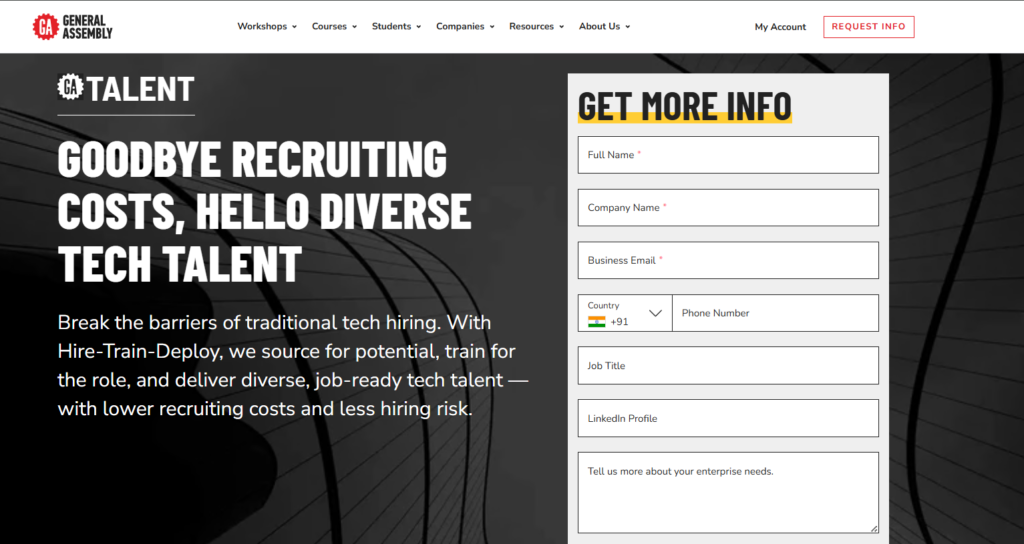
In addition to its professional training programs, General Assembly offers a structured hire train deploy model as part of its talent solutions for companies.
Source – General Assembly
Within this model, General Assembly sources candidates from its global learner and alumni ecosystem, as well as from community partnerships focused on expanding access to tech careers.
Then selected candidates undergo intensive, hands-on training that emphasizes real-world workflows, applied projects, and role-specific skill development. Here, training typically combines technical instruction, soft skills, and capstone projects before candidates are deployed to client organizations.
The deployment is usually contract-based, with General Assembly providing ongoing coaching and support through dedicated squad leaders. Organizations can also convert deployed talent into full-time roles based on performance and long-term needs.
What differentiates General Assembly’s hire train deploy offering is its strong emphasis on applied learning and diversity outcomes. Training is delivered by active industry practitioners, and the model is built to scale from small teams to large enterprise cohorts across multiple geographies.
Best suited for: Organizations looking to build technology teams through a hire train deploy model backed by a global tech education platform and practitioner-led training.
mthree
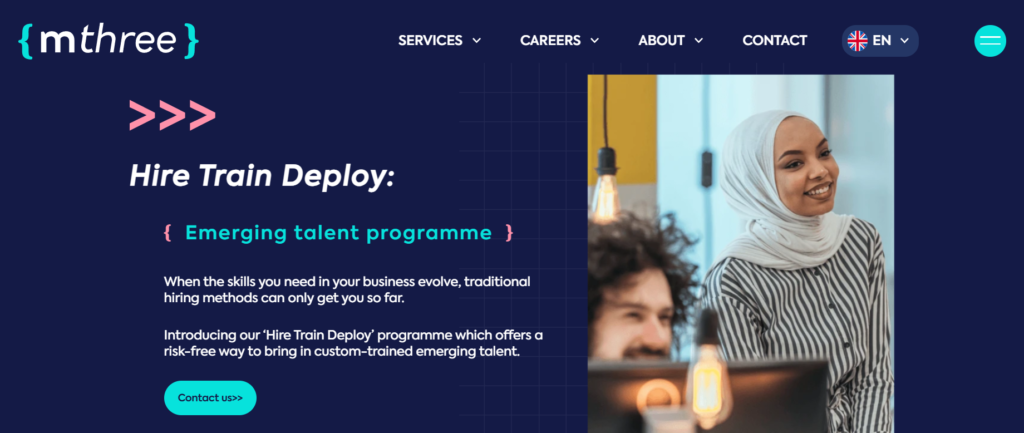
mthree is a global talent and training partner that works with organizations across North America, EMEA, and the APAC region to build technology and business capability through early-career and emerging talent programs.
The company focuses on equipping individuals with in-demand technical and professional skills while helping enterprises create sustainable, diverse talent pipelines aligned to their evolving workforce needs.
Source – mthree
Hire train deploy is a central part of mthree’s emerging talent offering. Through this model, mthree hires high-potential graduates and early-career professionals. They then train them in client-aligned technical and professional skills, and deploy them onsite as mthree employees for a fixed period, typically 12 to 24 months.
The training is tailored to the client’s technology stack and role requirements. It typically covers software development, data, cloud, DevOps, cybersecurity, AI, and business services.
At the end of the program, clients can convert deployed talent into full-time employees. What stands out in mthree’s hire train deploy approach is its focus on emerging talent pipelines, diversity outcomes, and long-term retention, making it a structured alternative to traditional graduate hiring and junior lateral recruitment.
Best suited for: Organizations looking to build scalable, diverse early-career talent pipelines across technology and business roles through a structured, low-risk hire, train, and deploy model.
A scorecard for the rest of your hiring panel. While you’re evaluating HTD partners, your lateral staffing panel is doing its own work in parallel. Our Vendor Consolidation Scorecard is a one-page framework to review those vendors across activity, quality, speed, commercials, and strategic fit.
L&T EduTech
L&T EduTech is a learning and assessment solutions provider backed by the Larsen & Toubro Group. The company works at the intersection of academia and industry, helping students, professionals, and enterprises build industry-aligned skills across engineering and technology domains.

Source – L&T EduTech
Hire train deploy is part of L&T EduTech’s broader workforce and enterprise skilling portfolio. Through this model, L&T EduTech helps organizations build a pipeline of job-ready talent by combining recruitment, role-based training, and deployment. The approach is designed to reduce hiring friction and align talent with both technical requirements and organizational culture before deployment.
Their training is structured around role or product-based skilling, with a strong emphasis on industry relevance. Candidates are prepared in advance, allowing enterprises to reduce onboarding time and minimize early productivity gaps. The model is positioned to support faster staffing in fluctuating-demand scenarios while maintaining consistency in skill readiness.
What differentiates L&T EduTech’s hire train deploy approach is its deep industry linkage and focus on enterprise alignment. The model is built to support organizations that require predictable, scalable talent pipelines backed by structured learning and assessment frameworks.
Best suited for: Enterprises looking for industry-aligned hire-train-deploy programs supported by a large engineering and technology ecosystem.
upGrad Enterprise
upGrad Enterprise is an enterprise learning and talent solutions provider focused on helping organizations build workforce capability from hire to retire. The company’s offerings span leadership development, tech and data skilling, sales enablement, and talent fulfillment programs.
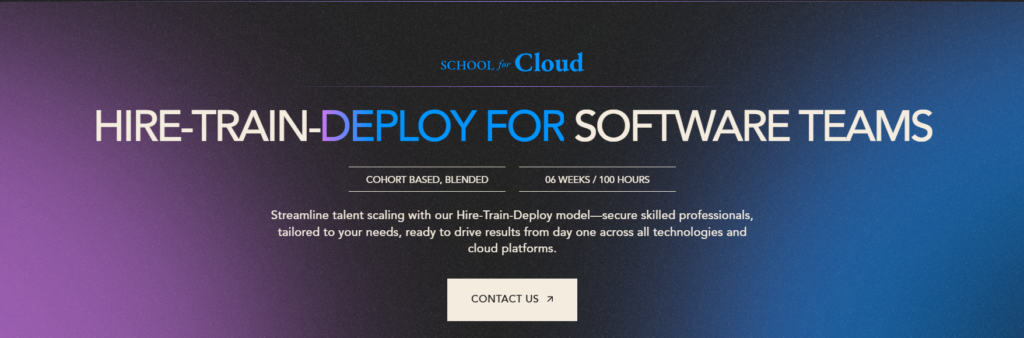
Hire train deploy sits within upGrad Enterprise’s Talent Fulfillment portfolio. Through this model, upGrad Enterprise helps organizations source, train, and deploy talent that is ready to contribute from day one. The programs are designed to support software teams and technology-driven functions that require scalable, project-ready capability.
Source – upGrad Enterprise
Their programs typically run for around six weeks, with a strong focus on hands-on learning and defined exit competencies. Candidates are trained on role-specific technical skills across software development, data, analytics, AI, and cloud platforms, aligned to enterprise requirements.
Once training is complete, candidates are deployed directly into business teams. They also use structured assessments both before and after training to ensure readiness prior to deployment.
What differentiates upGrad Enterprise’s hire, train, and deploy approach is its integration with a large-scale enterprise learning infrastructure. The model is supported by extensive content libraries, high program completion rates, and experience working with system integrators, data firms, and cloud-focused organizations.
Best suited for: Enterprises and system integrators looking to scale technology and software teams quickly using a structured hire train deploy model backed by enterprise-grade learning platforms.
Smoothstack
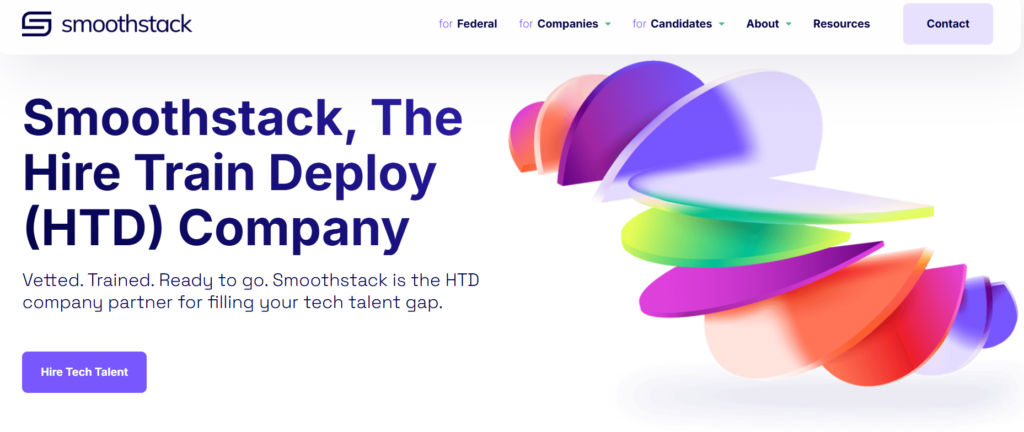
Smoothstack is a workforce transformation company focused on building job-ready technology talent for enterprises. The company positions itself around merit-based hiring, workforce equity, and readiness-driven outcomes.
They work primarily with organizations across sectors such as federal government, financial services, healthcare, semiconductors, and telecommunications in the US.
Source – Smoothstack
Hire train deploy is the core delivery model through which Smoothstack operates. The company partners with enterprises to understand their technology stack and delivery needs. It then identifies candidates based on aptitude and potential rather than resumes alone.
Selected candidates undergo intensive, immersive training designed around real-world enterprise environments. The training is customized to client requirements and can be completed in as little as eight weeks, depending on role complexity. The focus is on producing engineers who are ready to contribute immediately upon deployment.
What distinguishes Smoothstack’s hire train deploy approach is its merit-first philosophy and emphasis on net-new talent creation. The model is designed to reduce hiring risk while expanding access to technology careers for diverse and underrepresented talent pools.
Best suited for: Enterprises seeking custom-trained technology teams for emerging or hard-to-hire skill areas, particularly where speed, readiness, and retention are critical.
edForce
edForce is an enterprise workforce upskilling and training accelerator that works with organizations across industries to build job-ready capability.
The company supports enterprises with fresh hire onboarding, lateral training, certifications, assessments, CloudLabs, and large-scale workforce enablement. It is also an authorized training partner for major technology vendors, including AWS, Microsoft, NVIDIA, Cisco, Red Hat, and others.
Source – edForce
Hire train deploy is part of edForce’s broader workforce upskilling and talent fulfillment offering. Through this model, edForce takes ownership of the full talent lifecycle. This includes identifying suitable candidates, training them on role-specific technologies, and deploying them into organizations where their skills best align.
The training is customized to enterprise requirements and emphasizes hands-on learning. Candidates are trained on in-demand skills such as cloud, cybersecurity, data, AI and ML, DevOps, full stack development, ERP, and identity and access management.
Once deployed, edForce continues to support both the organization and the talent.
What stands out in edForce’s hire train deploy approach is its strong enterprise training foundation and ability to integrate certifications, labs, and assessments into deployment-ready programs at scale.
Best suited for: Enterprises and system integrators looking for project-ready talent through a hire, train, and deploy model backed by deep training, certification, and upskilling infrastructure.
Maintec Technologies
Maintec Technologies is a US-headquartered IT services and staffing company with deep expertise in mainframe systems, data center management, and enterprise IT operations.
Hire Train Deploy is part of Maintec’s staffing and consulting practice.
Source – Maintec
Under this model, Maintec sources candidates from multiple channels. These include fresh graduates, trainees, and early-career professionals. Candidates are then pre-screened through aptitude tests, interviews, and technical evaluations. Only those who meet role requirements move forward.
Training is role-specific and hands-on. It focuses on the exact technologies required for the client’s project. Once training is complete, candidates are deployed to client teams as project-ready resources.
Maintec’s Hire Train Deploy programs cover skills such as mainframe technologies, Java, .NET, Node.js, PHP, cloud computing, CICS, service desk operations, and networking. They monitor progress throughout training to ensure skills stay current.
Best suited for: Enterprises running legacy or hybrid IT environments that need cost-effective, trained resources through a Hire Train Deploy staffing model backed by long-standing mainframe and IT services expertise.
Mazenet
Mazenet is another long-standing workforce development and talent solutions company with experience in IT skilling, training, and enterprise talent delivery. The company works with enterprises, GCCs, and Fortune 500 organizations across India and global markets.
Source – Mazenet
Hire-Train-Deploy is a core delivery model within Mazenet’s talent solutions practice. Under this model, Mazenet manages the process end to end. It starts with requirement alignment and candidate sourcing. Candidates are hired based on defined role criteria. They are then trained on exact tools, technologies, and business processes required for the role.
The candidates’ skills are validated continuously through practical evaluations using Mazenet’s LMS and assessment engine. Only candidates who meet role readiness benchmarks move forward.
Once trained, talent is deployed into live business environments. Enterprises can opt for contract-to-hire or direct hiring models, depending on workforce strategy and timelines.
Mazenet delivers HTD through two primary models:
- Source, Hire, Train & Deploy for immediate, job-ready deployment
- Train & Hire for planned hiring and long-term talent pipelines
This approach is commonly used for digital roles, cloud, data, analytics, ERP, and other high-demand IT skills.
Best suited for: Enterprises and GCCs that require bulk or urgent hiring of role-ready talent, and want a long-term workforce partner rather than a transactional staffing vendor.
Now that we had a look at these companies, let’s see how they compare to each other.
A Side-by-Side Comparison of Leading Hire-Train-Deploy Companies
| Company Name | Primary Talent Focus | How Talent Is Sourced | Training & Readiness Model | Deployment & Post-Deployment Support | Best Fit For |
| Global Skills | Role-ready engineers across cybersecurity, networking, automation, cloud, infrastructure, and emerging enterprise tech | Multi-source pools covering early-career engineers, experienced professionals, and adjacent skill profiles; sourcing expands based on client demand | Client-driven training aligned to tools, processes, delivery context, and expectations; capability built before deployment | Active post-deployment monitoring, performance tracking, skill reinforcement, and outcome alignment; access to experienced SMEs when required | Enterprises and GCCs that need predictable, role-ready capability for both bulk hiring and niche, high-impact roles |
| TeamLease EdTech | Early-career and graduate talent | University and academic partnerships across India’s higher education ecosystem | Role-aligned training delivered through structured programs and LMS-based progress tracking | Deployment after readiness validation; post-deployment monitoring to support early productivity | Organizations looking to build large-scale fresher pipelines and campus-to-corporate transitions |
| Alp Consulting | Freshers and experienced candidates across multiple industries | Candidate sourcing based on aptitude and role fit across diverse sectors | Short-duration, customized training (typically 4-6 weeks) focused only on role-required skills | Contractual deployment with ongoing support and potential permanent absorption | Companies needing flexible HTD support across IT, manufacturing, semiconductor, EV, healthcare, and GCC environments |
| General Assembly | Technology professionals across engineering, data, product, and UX roles | Global learner and alumni network plus community partnerships | Intensive, hands-on training with applied projects, real workflows, and practitioner-led instruction | Contract-based deployment with coaching via squad leaders; option to convert to full-time | Enterprises seeking applied, practitioner-led HTD programs with strong diversity and global reach |
| mthree | Emerging and early-career technology and business talent | Graduate and early-career hiring focused on aptitude and diversity | Client-aligned technical and professional skills training covering software, data, cloud, AI, and business services | Deployment as mthree employees for 12-24 months; high conversion to FTE roles | Organizations building structured, diverse early-career pipelines with long-term retention goals |
| L&T EduTech | Engineering and technology talent aligned to industry needs | Recruitment integrated with academic and enterprise skilling initiatives | Role- or product-based skilling with strong assessment and industry relevance | Deployment designed to reduce onboarding time and productivity gaps | Large enterprises seeking industry-aligned, scalable HTD programs backed by a major engineering ecosystem |
| upGrad Enterprise | Software, data, AI, and cloud professionals | Sourcing aligned to enterprise and system integrator requirements | Six-week, hands-on programs with defined exit competencies and structured assessments | Direct deployment into business teams after readiness validation | System integrators and enterprises scaling technology teams using enterprise-grade learning platforms |
| Smoothstack | Net-new, job-ready technology talent | Aptitude-based sourcing focused on potential rather than resumes | Immersive, customized training built around real enterprise environments, often completed in ~8 weeks | Deployment after training validation; strong focus on retention and readiness | US-based enterprises needing fast, merit-driven capability for emerging or hard-to-hire tech skills |
| edForce | Enterprise-ready IT and digital talent across cloud, data, AI, security, and ERP | Candidate identification tied to enterprise training and certification programs | Customized, hands-on training integrated with certifications, labs, and assessments | Continued support for both talent and enterprise after deployment | Enterprises and SIs seeking HTD backed by deep training, certification, and lab infrastructure |
| Maintec Technologies | IT professionals for mainframe and hybrid environments | Multi-channel sourcing of fresh graduates, trainees, and early-career professionals | Role-specific, hands-on training focused on exact client technologies | Deployment as project-ready resources with ongoing progress monitoring | Enterprises operating legacy or hybrid IT stacks needing cost-effective trained resources |
| Mazenet | IT and digital talent for enterprises and GCCs | Requirement-led sourcing and hiring from large talent pools | Role-specific training with continuous skill validation via LMS and assessment engines | Deployment through contract-to-hire or direct hiring models | Enterprises and GCCs needing bulk or urgent deployment of consistently trained, job-ready talent |
Key Factors to Look for in a Hire-Train-Deploy Partner in 2026
As the Hire-Train-Deploy model gains wider adoption, the decision is no longer about whether to use it or not, but how to evaluate providers effectively.
Not all companies operate at the same level of execution or accountability. When assessing partners in 2026, enterprises should pay close attention to the following factors:
- Role readiness definition and validation: It is a good idea to check how the provider defines “job-ready.” Strong partners train talent against real tools, workflows, and delivery environments, and validate readiness through practical assessments before deployment.
- Depth and flexibility of talent sourcing: Evaluate whether the provider can source talent across different stages in career and adjacent skill profiles. This flexibility is critical for supporting both bulk hiring and niche requirements.
- Post-deployment engagement and accountability: A reliable partner does not disengage after deployment. Ongoing performance monitoring, skill reinforcement, and outcome alignment are indicators of long-term delivery responsibility.
- Scalability across use cases: The right Hire-Train-Deploy partner should support enterprise-scale programs as well as specialized roles without compromising quality or consistency.
These criteria help distinguish top workforce partners from transactional staffing vendors. This is why organizations increasingly look for providers that are built around capability, accountability, and enterprise readiness. And this is how Global Skills approaches Hire-Train-Deploy model in practice.
Why Global Skills Is the Hire-Train-Deploy Partner Enterprises Choose
Global Skills was built to solve a problem enterprises face every day: talent that looks qualified on paper but falls short in real-world delivery. We address this gap by focusing on capability first, not just credentials.
Hire-Train-Deploy is one of the ways we do this. We support niche roles that demand precision, bulk hiring programs that require consistency, and critical initiatives where accountability matters. Our approach also extends beyond HTD to include permanent staffing, contract-to-hire, contingent staffing, and flexible deployment models aligned to enterprise needs.
Across cybersecurity, automation, cloud, infrastructure, and emerging technologies, we align talent to real delivery environments, not assumptions. When required, we also deploy experienced subject matter experts to stabilize projects, bridge capability gaps, and ensure continuity at scale.
If you are evaluating partners for predictable, performance-driven hiring in 2026, get in touch with us. Let’s together assess your requirements and build a capability that actually delivers.
Frequently Asked Questions
1. What is Hire-Train-Deploy and how does it work in real enterprise projects?
Hire-Train-Deploy is a workforce model where talent is hired first, trained on role-specific tools and environments, and deployed only after readiness is validated. In real enterprise projects, this means engineers join teams already familiar with the stack, workflows, and delivery expectations, reducing ramp-up time and delivery risk.
2. How long does a Hire-Train-Deploy engagement typically take from requirement to deployment?
Timelines vary based on role complexity and scale, but most Hire-Train-Deploy programs run between 6 to 12 weeks. This includes sourcing, role-aligned training, assessments, and deployment. For niche skills or advanced roles, timelines may extend slightly to ensure readiness before deployment.
3. What types of roles are best suited for the Hire-Train-Deploy model?
Hire-Train-Deploy works best for technology and engineering roles where delivery readiness matters. This includes cybersecurity, cloud, automation, data, DevOps, software development, infrastructure, and emerging tech roles. It is especially effective when skills are scarce, evolving, or difficult to hire laterally.
4. Can Hire-Train-Deploy work for niche or emerging technologies, not just bulk hiring?
Yes. Hire-Train-Deploy is highly effective for niche and emerging technologies. When lateral hiring is not viable, candidates with adjacent skills can be trained on new platforms or tools. This allows enterprises to build capability early, without waiting for the market to mature or paying premium hiring costs.
5. How do enterprises evaluate talent quality before final deployment?
Talent is evaluated through structured assessments, practical exercises, and role-based validation during training. Many providers also include client interviews or pilot evaluations before deployment. This ensures that only candidates who meet defined readiness benchmarks are deployed into live environments.
6. Is Hire-Train-Deploy suitable for GCCs and long-term capacity planning?
Yes. GCCs use Hire-Train-Deploy to build predictable, scalable capability without constant hiring cycles. The model supports steady capacity growth, consistent skill alignment, and reduced dependency on lateral hiring, making it well-suited for long-term workforce planning and controlled expansion.
7. How does Hire-Train-Deploy compare with contract-to-hire and permanent hiring models?
Hire-Train-Deploy prioritizes readiness before deployment, unlike traditional hiring models that rely on resumes and post-hire onboarding. Contract-to-hire and permanent hiring focus on employment terms, while Hire-Train-Deploy focuses on capability outcomes first, with flexibility to convert talent later.
8. Can Hire-Train-Deploy talent be converted into full-time employees later?
Yes. Many enterprises use Hire-Train-Deploy as a pathway to permanent hiring. Once talent proves performance and cultural fit, organizations can convert deployed professionals into full-time roles, after paying a pre-defined fee.
Disclaimer: The information in this article is based on publicly available sources, including company websites and published materials, at the time of writing. While efforts have been made to ensure accuracy, Global Skills does not guarantee completeness or ongoing validity. Readers should verify details directly with the respective companies. If any information requires correction or clarification, please feel free to contact us.